

REDUCING STORMWATER RUNOFF
What is Stormwater Runoff and Why Do We Need to Reduce It?
Stormwater runoff is rainfall that flows over the ground surface. It is created when rain falls on roads, driveways, parking lots, rooftops and other paved surfaces that do not allow water to soak into the ground. Stormwater runoff is the number one cause of stream impairment in urban areas. Where rain falls on paved surfaces, a much greater amount of runoff is generated compared to runoff from the same storm falling over a forested area. These large volumes of water are swiftly carried to our local streams, lakes, wetlands and rivers and can cause flooding and erosion, and wash away important habitat for critters that live in the stream.
Stormwater runoff also picks up and carries with it many different pollutants that are found on paved surfaces such as sediment, nitrogen, phosphorus, bacteria, oil and grease, trash, pesticides and metals. These pollutants come from a variety of sources, including pet waste, lawn fertilization, cars, construction sites, illegal dumping and spills, and pesticide application. Researchers have found that as the amount of paved surfaces (a.k.a. impervious cover) in the watershed increases, stream health declines accordingly. Click here for a full report on the impacts of impervious cover on streams, lakes and wetlands.
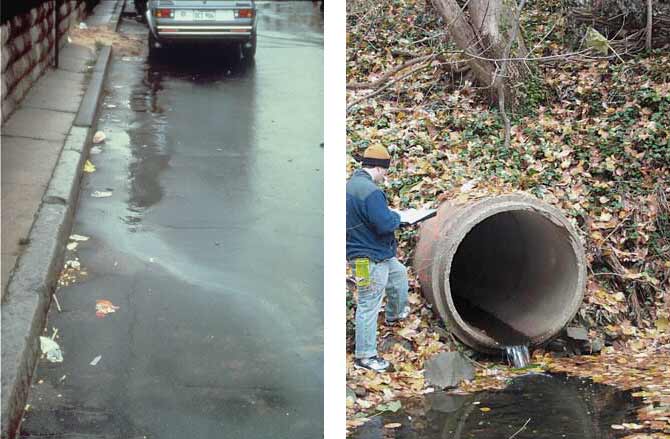
To counteract these impacts of stormwater runoff, most municipalities have adopted regulations that require management of stormwater for all new development. Stormwater management is the use of specific practices, constructed or natural, to reduce, temporarily detain, slow down and/or remove pollutants from stormwater runoff. Stormwater management practices are essentially designed to restore or mimic some of the natural processes provided by the vegetative cover that existed prior to land disturbance. In many regions of the country, this native vegetative cover includes trees and shrubs.
Preserving undisturbed vegetative cover during land development is a much more cost effective approach than destroying these features and having to construct new stormwater management practices to replace the functions they originally provided. Trees, forests and other vegetation and their associated soils are often referred to as "green infrastructure" when they are used to manage stormwater runoff instead of or in addition to pipes, pumps, storage chambers or other "hard infrastructure." Municipalities are beginning to realize the many stormwater benefits of green infrastructure, and are encouraging the use of stormwater management practices that conserve forests and incorporate vegetative features. EPA’s green infrastructure website provides a wealth of information on this topic.
How Do Trees Reduce and Remove Pollutants from Stormwater Runoff?
Trees and forests improve stream quality and watershed health primarily by decreasing the amount of stormwater runoff and pollutants that reaches our local waters. Trees and forests reduce stormwater runoff by capturing and storing rainfall in the canopy and releasing water into the atmosphere through evapotranspiration. In addition, tree roots and leaf litter create soil conditions that promote the infiltration of rainwater into the soil. This helps to replenish our groundwater supply and maintain streamflow during dry periods.
The presence of trees also helps to slow down and temporarily store runoff, which further promotes infiltration, and decreases flooding and erosion downstream. Trees and forests reduce pollutants by taking up nutrients and other pollutants from soils and water through their roots, and by transforming pollutants into less harmful substances. In general, trees are most effective at reducing runoff from smaller, more frequent storms. The Center for Urban Forest Research, Pacific Northwest Research Station, USDA Forest Service provides a fact sheet on the use of trees to reduce stormwater runoff.
In addition to these stormwater benefits, trees provide a host of other benefits such as improved air quality, reduced air temperatures in summer, reduced heating and cooling costs, increased property values, habitat for wildlife, and recreation and aesthetic value.
The City of Vancouver, Washington recognizes the important connection between forests and stormwater runoff and have included Urban Forestry in the City's stormwater management plan, which represents a comprehensive watershed approach to improving water quality. In addition, 100% of the stormwater utility fees collected are used to support the Urban Forestry Division.
How Do We Measure and Provide ‘Credit’ for Stormwater Runoff Reduction by Trees?
So, if trees are so great, why isn’t everyone using them to meet their stormwater management needs? One of the reasons is that developers have no incentive to use them unless they can get credit for it and most municipalities do not provide these credits. Municipalities that do provide credits may not provide enough to act as a true incentive.
A stormwater credit system reduces the stormwater management requirements a developer has to meet in exchange for conserving forests or using site design techniques that reduce the amount of paved surfaces created. The credit system directly translates into cost savings for the developer by reducing the size of stormwater management practices that must be constructed. Click here for more information on stormwater credits for trees.
In most municipalities around the country with stormwater management regulations, site designers are required to capture and remove pollutants from a specified runoff volume and control the maximum (or peak) rate of runoff from the site for certain size storm events. Under this scenario, water quality 'treatment' is defined solely by the pollutant removal functions of the stormwater management practices used, and does not account for their ability to reduce the overall volume of runoff. A number of states and communities are beginning to recognize that there are benefits of shifting from this peak-based stormwater control to an approach that focuses on reducing the volume of runoff (though re-use, evapotranspiration, or infiltration) leaving a site. A volume reduction approach is most appropriate for the relatively small, frequent storms, which matches up well with the stormwater benefits provided by trees. Click here for more on the runoff reduction approach that is proposed in the State of Virginia.
Reducing runoff volume using green infrastructure has benefits beyond just removing pollutants. It also recharges groundwater, provides better protection of sensitive aquatic resources, and reduces the size and cost of hard infrastructure that would otherwise need to be constructed. One challenge with this approach has been how to account for the runoff reduction provided by green infrastructure in rainfall/runoff models commonly used by engineers. Click here for a summary of how to account for trees and other green infrastructure in stormwater models and calculators.
What Are Some Specific Practices That Use Trees to Reduce Stormwater Runoff?
Conserving natural areas such as forests can reduce the amount of runoff that is createdThe most effective way to minimize the impacts of stormwater runoff described above is to limit the amount of paved surfaces that are created during development, and preserve as much as possible the natural topography and vegetation. Specifically, existing forests can be protected during construction and permanently managed as conservation lands. In cases where there are no existing forest stands (e.g., development of a former farmland), reforestation can help to offset these impacts.
This stormwater management practice slows down and filters pollutants from runoff from the adjacent rooftops and drivewayThe impacts of stormwater runoff can also be minimized by increasing tree canopy over paved surfaces to increase interception of rainfall. Another way to minimize impacts is by “disconnecting” paved surfaces so that they no longer drain to the system of gutters, inlets and pipes that make up the storm drainage system and ultimately flow to our local streams and rivers. Disconnection can involve redirecting runoff from rooftops or individual parking lots to stormwater management practices or vegetated areas and allowing the runoff to slowly soak into the ground.
Most stormwater management practices that incorporate vegetation have relied primarily on herbaceous vegetation with few trees and shrubs. The reason for this is that engineers are often concerned that tree roots, branches and leaves will compromise the effectiveness or stability of the practice. When trees are planted in stormwater management practices, they often die because of harsh conditions or they are removed by maintenance crews or overzealous homeowners.
To address these concerns, the Center for Watershed Protection and the USDA Forest Service held a series of workshops attended by stormwater engineers, foresters, arborists, soil scientists, landscape architects and other experts that resulted in the development of new designs for stormwater management practices. The goal of the workshops was to identify potential limitations to planting trees in stormwater management practices, both from an engineering perspective and from the standpoint of tree survival and health. The resulting designs for so-called “stormwater forestry practices” were intended to address these limitations through design modifications, species selection, or other methods. A major goal of these designs is to harness the numerous benefits of trees to increase the effectiveness of stormwater practices, while providing other benefits to the community, such as cooling and shade, aesthetics, and wildlife habitat. Links to the conceptual designs are provided below.
- Wooded wetland
- Emergent pond/wetland system
- Bioretention and bioinfiltration facilities
- Alternating side slope plantings
- Tree check dams
- Forested filter strip
- Multi-zone filter strip
- Linear storm water tree pit
- Stormwater treatment dry ponds
A forested filter strip treats stormwater runoff using trees as part of the design
Resources for Using Trees to Reduce Stormwater Runoff
- Using Trees to Reduce Stormwater Runoff. This Powerpoint slideshow covers many of the topics presented on this webpage. Click on the link above to view the slideshow or download the Powerpoint file from Slideshare so you can give the presentation yourself.
- Urban Watershed Forestry Manual Part 2: Conserving and Planting Trees at Development Sites. by the Center for Watershed Protection and USDA Forest Service, 2006. Chapter 3 of this manual deals with incorporating trees into stormwater management practices.
- Using Vegetative Systems to Manage Stormwater Runoff: 10 Case Studies. This fact sheet summarizes some great case studies of communities using trees to reduce stormwater runoff.
- Wetlands and Watersheds Article 5: The Next Generation of Stormwater Wetlands. Center for Watershed Protection, 2008. This article presents new designs for stormwater wetlands that incorporate trees.
- Green Streets: Innovative Solutions for Stormwater and Stream Crossings. Portland Metropolitan Council, 2002. 144 p.
- City Trees: Sustainability Guidelines and Best Practices. Bonestroo and Tree Trust, 2007. 41 p.
- Trees: The Oldest New Thing in Stormwater Treatment? by Janis Keating. Stormwater. March/April, 2002.
- Plants for Stormwater Design, Volume I. Species Selection for the Upper Midwest. D. Shaw and R. Schmidt, 2003. Minnesota Pollution Control Agency.
- Plants for Stormwater Design, Volume II. Species Selection for the Upper Midwest. D. Shaw and others, 2007. Great River Greening.
- How Green Infrastructure Measures Up to Structural Stormwater Services by Cheryl Kollin. Stormwater. July/August 2006.
- Rooftops to Rivers: Green Strategies for Controlling Stormwater and Combined Sewer Overflows by C. Klauss and C. Calarusse. 2006. Natural Resources Defense Council.
- Stormwater Strategies: Community Responses to Runoff Pollution by P.H. Lehner, G.P. Aponte Clarke, D.M. Cameron and A.G. Frank. 1999. Natural Resources Defense Council.
- Chesapeake Stormwater Network website. This site contains proposed design specifications for stormwater BMPs in the Chesapeake Bay.
- Stormwater Management: Using Trees and Structural Soils to Improve Water Quality. This website, developed by Virginia Tech, contains a suite of technology transfer resources for implementing stormwater management practices.
- The Conservation Fund's Green Infrastructure website
- The Low Impact Development Center's Green Streets website
- Letter Agreement between EPA and the District of Columbia regarding the District of Columbia Municipal Separate Storm Sewer System Best Management Practice Enhancement Program. This innovative approach requires the use of tree canopy, low impact development practices, rain gardens and green roofs to mitigate MS4 stormwater runoff.
- The City of Philadelphia Office of Watersheds developed a Green City, Clean Waters Plan to combine green and gray infrastructure practices to control Combined Sewer Overflows
- Bonestroo has compiled a summary of literature related to trees and stormwater runoff.
- Presentations, handouts and related materials presented at the September 28, 2010 Trees & Stormwater Symposium, a day-long event dedicated to the promotion of integrating trees with stormwater management. The symposium, organized by Bonestroo, featured leading practitioners and researchers, including Swedish expert Örjan Stål
- The Milwaukee Metropolitan Sewerage District's Fresh Coast, Green Solutions plan outlines an approach to using both green and grey infrastructure to reduce sewer overflows and improve water quality.
- New York City's Green Infrastructure Plan outlines their integrated green and grey infrastructure approach to water quality management.
- The Watershed Management Group's Green Infrastructure for Southwestern Neighborhoods guide provides design guidance for green infrastructure that is tailored to the development patterns, climate and vegetation of the southwest U.S.